
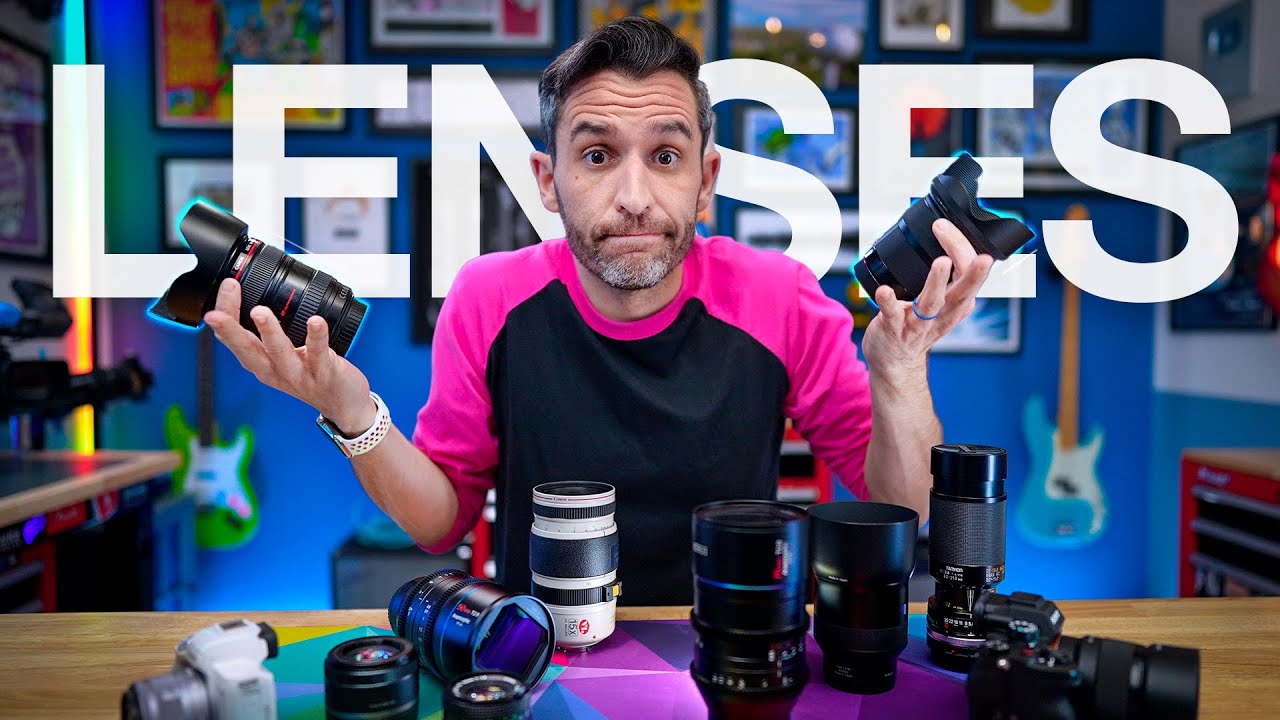
The video “A Beginner’s Guide to Camera Lenses: What to Buy First?” offers a friendly, straightforward roadmap to help you pick lenses that match your shooting style and budget. Tom Buck explains lens functions, practical buying advice, and hands-on tips so you can feel confident making your first lens purchase.
You’ll find clear explanations of the three most important lens features, lens mounts, focal lengths and crop factors, plus why aperture affects depth of field and low-light performance. It also walks through camera and lens recommendations, Tom’s three favorite lenses, whether pricey glass is worth it, and practical tricks like using Canon lenses on Sony bodies so you can choose what to buy first.
This image is property of i.ytimg.com.
Understanding Camera Lenses
What a lens does and how it shapes an image
A lens is the part of your camera that decides how the world falls into the frame. It gathers light, bends it, and focuses it onto the sensor, and in that small, technical act it chooses what becomes clear and what becomes soft, what is included and what is cropped out. You might think of it as the translator between reality and photograph: the same scene will feel different through different lenses because each one frames, compresses, and renders light in its own way.
Basic optical construction: elements, groups, and coatings
Inside a lens there are glass elements grouped and arranged to correct various visual flaws — curvature, chromatic aberration, astigmatism — and to produce the look you want. Manufacturers describe lenses by elements and groups, which is a shorthand for complexity and cost, and you’ll sometimes see exotic glass or aspherical elements mentioned when a lens tacks down a specific problem. Coatings are quieter but crucial: anti-reflective coatings reduce flare, maintain contrast, and give colours more neutrality. When you hold a lens you feel its weight and finish, but those inner choices quietly shape every pixel.
How lens characteristics affect sharpness, contrast, and distortion
Sharpness isn’t just one thing; it’s centre sharpness, edge sharpness, micro-contrast and perceived detail. Wide-angle lenses often show more distortion and softer edges at wide apertures; telephotos can be rock-solid in the centre yet still reveal chromatic fringes on high-contrast edges. Contrast is affected by coatings and the internal construction, and distortion (barrel or pincushion) is something lenses either hide well or wear on their sleeve. You’ll notice these traits most when you pixel-peep, but they also change how an image feels — clinical and precise or soft and romantic.
How lens choice interacts with camera sensor and camera settings
Your lens doesn’t exist alone: it works with your sensor size, resolution, focus system and in-camera corrections. A high-resolution sensor will expose flaws in a marginal lens, while in-body stabilization or in-lens IS can let you shoot at slower speeds. Camera settings — shutter speed, ISO, aperture — are conversations between lens and body. Choosing a lens means thinking about what you want the sensor to record and how you’ll control light and depth in the moment.
The Three Most Important Things to Look For
Focal length: how it determines angle of view and framing
Focal length is how a lens determines what you include in the frame. Short focal lengths (wide lenses) give you a broad view and strong perspective; long focal lengths (telephotos) narrow your view and compress distance. Understanding focal length is about seeing in advance what you’ll capture: do you want a sweeping landscape or an intimate face? The focal length you choose dictates where you stand, how you place your subject, and how the background behaves.
Maximum aperture: light gathering, low-light performance, and depth of field
Maximum aperture — those f-numbers — tell you how much light a lens will let through and how much control you’ll have over depth of field. A wide aperture like f/1.4 or f/1.8 gives you more light and creamier background separation; that helps in low light and when you want the subject to pop. But faster apertures add weight and cost, and sometimes optical compromises. You should think about how often you truly need f/1.4 versus how often you’d be content with f/2.8 or f/4.
Optical quality and practical considerations like weight and size
Optical quality includes resolution, contrast, bokeh rendering, and resistance to flare. Practical considerations matter too: a heavy, large lens can become a chore, constraining the kinds of shoots you’ll actually do. If you travel light, a compact lens that sacrifices a little optical perfection might be better than a perfect lens you never pack. Consider handling, balance on your body, and whether you’ll need filters or a hood that changes the lens’ profile.
Lens Mounts and Compatibility
Common mounts and manufacturers: Canon EF/RF, Nikon F/Z, Sony E, Micro Four Thirds, etc.
Each camera ecosystem has its own mount: Canon has EF (older DSLRs) and RF (mirrorless), Nikon has F and Z, Sony uses E for mirrorless, and the Micro Four Thirds system is shared by Olympus and Panasonic. The mount defines mechanical fit, electronic communication, and thus how AF, aperture control and stabilization work. When you choose a lens, you’re choosing a relationship with a system, and staying within that system usually gives you the smoothest experience.
How to check compatibility between bodies and lenses
Compatibility is about both physical fit and electronic control. Check whether a lens is designed for full-frame or crop sensors, whether the mount matches your body, and whether autofocus and aperture control are supported. Manufacturers’ markings tell you a lot (EF, RF, Z, E, MFT), but the simplest habit is to confirm model-to-body compatibility in the manual or product description before buying. If you ignore this, you’ll end up with a lens that mounts but doesn’t autofocus, or that vignettes badly.
Using adapters: mechanical vs electronic adapters and trade-offs
Adapters let you use lenses from other systems, and they come in two flavors: simple mechanical adapters that act like a spacer, and electronic adapters that translate signals so autofocus and aperture control still work. Mechanical adapters are cheap and useful for manual lenses; electronic adapters are more expensive and can be imperfect, affecting speed or introducing quirks. You trade convenience for flexibility, and sometimes the pleasure of adapting old glass — with its character — is worth a little lost auto-everything.
Flange focal distance and why it matters for adapting lenses
Flange focal distance is the space between the lens mount and the sensor. It’s why mirrorless cameras can adapt many DSLR lenses: they have shorter flange distances, so adapters can make up the difference. If the lens’s flange distance is longer than the camera’s, you can usually adapt with a simple adapter; if it’s the other way round, you can’t focus to infinity without optical correction. It’s a small technical detail with big practical consequences for what lenses you can borrow or buy used.
Focal Lengths and Crop Factors
Understanding full-frame, APS-C, Micro Four Thirds and how crop factor changes effective focal length
Sensor size changes the angle of view: a smaller sensor crops the image the lens projects, so a 50mm on APS-C (crop factor ~1.5) looks more like a 75mm on full-frame. Micro Four Thirds with a 2x crop doubles that effect. The focal length doesn’t physically change, but the field of view does, and that’s why photographers talk about “equivalent focal lengths” to help you compare systems. You should consider crop factor when choosing lenses so the focal lengths you buy match your compositional goals.
Typical focal lengths and their photographic uses: wide, standard, telephoto
Broadly: wide lenses (10–35mm on full-frame) are for landscapes and interiors, giving you breadth and a sense of space; standard lenses (35–70mm) feel natural and versatile — they approximate how you see; telephotos (85mm and up) compress distance, isolate subjects, and suit portraits and distant details. You’ll notice overlaps and personal preferences: some people love 35mm as a one-lens solution, others swear by the rendering of a classic 85mm for portraits.
How to think about equivalent focal lengths across systems
Think in terms of the look you want rather than raw numbers. If you’re used to a 50mm on full-frame and you switch to APS-C, look for a 35mm if you want a similar field of view. Focal length equivalence is a translator that keeps your visual expectations consistent when you change systems. It helps you plan purchases and avoid surprises when your new camera crops more than you expect.
Practical examples: which focal lengths to try first for portraits, landscapes, and street
Start with practical focal lengths for each genre. For portraits try 50mm or 85mm on full-frame (35mm or 50mm on APS-C). For landscapes try 16–35mm on full-frame (10–22mm on crop). For street photography try 28–35mm or a compact 35mm prime — it’s wide enough for context, close enough for intimacy. These aren’t rules as much as useful habits; once you try them you’ll know which feels right for your way of seeing.
Aperture Explained
What aperture numbers mean and how they relate to exposure
Aperture numbers (f-stops) are fractions: f/2 is wider than f/4, letting in twice as much light. Change the aperture and you change exposure and depth of field; change shutter speed or ISO and you compensate. Each full stop halves or doubles the light. Understanding aperture is understanding a choreography of exposure: you move one setting and the others respond to keep the image balanced.
Depth of field and bokeh: creative uses of aperture
A wide aperture gives you a shallow depth of field, which isolates subjects against a soft background. That soft background quality — bokeh — depends on aperture shape and optical design, and it’s a creative tool you can use to direct attention. Stopping down increases depth of field so more of the frame reads as sharp. Play with aperture and you’ll discover how it controls narrative: intimate portraits, moody environmental shots, or crisply layered landscapes.
Low-light performance and why fast apertures are desirable
Fast apertures matter when you shoot in low light without raising ISO too much or dragging shutter speed into blur. Lenses with f/1.4 or f/1.8 let you keep shutter speeds that freeze motion and ISOs that preserve clean tone. They also let you be selective with focus, which is helpful in dim interiors or evening portraits. But they cost more, and the advantage shrinks if your camera has very good high-ISO performance or stabilization.
Trade-offs: sharpness across the frame, vignetting, and cost
Fast apertures bring trade-offs: many lenses are softer at their widest, show vignetting (darker corners), and cost significantly more. Stopping down improves sharpness and reduces vignetting, so you often get the best results a couple of stops from wide open. Consider how often you really need that wide aperture and whether the cost and extra bulk are worth the visual payoff.
Prime vs Zoom Lenses: Which to Buy First
Advantages of prime lenses for image quality, aperture, and learning composition
Primes tend to be sharper, faster and lighter than zooms at the same price point. They force you to move physically to change framing, which is a useful discipline that teaches composition and spatial awareness. If you want beautiful background separation and low-light performance for portraits or moody filmic shots, a prime is a brilliant teacher and a reliable tool.
Advantages of zoom lenses for flexibility and convenience
Zooms give you flexibility: a single zoom can cover what would otherwise be several primes, saving you time, space and the chore of changing lenses. For travel, events, or run-and-gun shooting, a zoom prevents missed moments and simplifies workflow. The convenience often outweighs the slight optical compromises, especially early on when you’re learning or need versatility.
When a versatile zoom is the better first purchase
If you shoot varied subjects, travel a lot, or want to avoid carrying multiple lenses, a versatile zoom like a 24–70 or 24–105 equivalent is often the best first buy. It covers standard to short-telephoto ranges and lets you learn focal-length preferences before committing to primes. It’s a pragmatic choice: you’ll take more photos and learn faster when gear isn’t a constant friction.
Recommended starter primes and starter zooms and why they make good first lenses
Good starter primes include 50mm f/1.8 (cheap, sharp, great for portraits and general use) and 35mm f/1.8 (more context for street and documentary work). Starter zooms include 24–70 f/4 or 24–105 f/4 for full-frame or the standard 18–55 kit zoom for APS-C — compact, flexible, inexpensive. These lenses give you a clear sense of what you like without breaking the bank.
Kit Lens vs First Upgrade Lens
What kit lenses typically offer and when they’re sufficient
Kit lenses are designed to be versatile and affordable: they usually cover a useful zoom range and deliver decent image quality in everyday conditions. For learning basics, travel snapshots, and early experimentation, they’re often entirely sufficient. You’ll be surprised how much better technique improves images even with modest glass.
Signs it’s time to upgrade from a kit lens
Upgrade when you feel limited: you can’t get the depth-of-field separation you want, autofocus is too slow, sharpness at your preferred apertures disappoints, or you frequently work in low light and wish for wider apertures. Also consider upgrading when you want a different aesthetic the kit lens doesn’t offer — creamier bokeh, better edge-to-edge clarity, or weather sealing for demanding conditions.
Common first upgrades: 50mm prime, 35mm prime, 24-70 equivalent zoom
The classic first upgrades are the 50mm prime for its simplicity and portrait friendliness, the 35mm prime for wider everyday work, and the 24–70 equivalent zoom for professional flexibility. These lenses teach different lessons: the primes teach you to move and frame, the zoom lets you explore focal ranges without swapping glass.
How to evaluate whether to buy a new lens or get better with the kit lens first
Reflect honestly on whether technique or equipment is the bottleneck. If you’re not practicing composition, lighting, and focus yet, the kit lens will serve you while you build skill. But if you repeatedly hit the same limits — soft edges, inability to isolate subjects, or poor low-light results — then a targeted upgrade will accelerate your progress.
Lens Recommendations by Beginner Type
Portrait beginners: focal lengths and aperture suggestions and specific lens models
If portraits are your focus, aim for 50mm or 85mm on full-frame (35mm or 50mm on APS-C), ideally with a wide aperture like f/1.8 or f/1.4 for subject separation. A 50mm f/1.8 is inexpensive and versatile; an 85mm f/1.8 gives flattering compression for head-and-shoulders. You don’t need the most expensive glass to make portraits that feel intimate and honest.
Travel and street beginners: compact zooms and wide primes that balance quality and portability
For travel and street, you’ll value compactness and flexibility. A 24–70 f/4 (or the crop equivalent) or a compact 24–105 balances range with size. Alternatively, a 35mm or 28mm prime is small, fast, and unobtrusive — perfect for blending into the scene. Choose lenses you’ll actually carry; the best lens is the one you bring with you.
Landscape beginners: wide-angle options and stopped-down sharpness considerations
Landscapes reward wide angles and sharpness across the frame. Think 16–35mm or 10–22mm depending on sensor size, and plan to stop down to f/8–f/11 for maximum depth and edge-to-edge clarity. A stabilized lens helps for hand-held dawn shots, but a tripod and a modest lens with good sharpness at mid-apertures will serve you well.
Video and filmmaking beginners: parfocal/servo-friendly lenses, stabilization, and aperture control
For video, look for lenses that focus smoothly, have linear aperture rings, and ideally behave parfocally (hold focus while zooming). Optical or in-body stabilization is helpful for hand-held work, and a constant-aperture zoom like a 24–70 f/2.8 makes exposure simpler during zooms. Also consider focus-by-wire characteristics and whether the lens supports reliable continuous AF if you plan run-and-gun work.
My Three Most Used Lenses and Why They Matter
Typical trio for many creators: wide-ish, standard prime, short telephoto and what each covers
A common, effective trio is a wide-ish lens (24mm or 35mm), a standard prime (35mm or 50mm), and a short telephoto (85mm). The wide gives context and atmosphere, the standard prime is your day-to-day eye, and the short telephoto isolates and flatters. Together they cover most photographic needs without redundancy.
How such a set teaches composition, framing, and lens-specific techniques
Using this set repeatedly teaches you how focal length dictates movement — when to step closer, when to zoom with your feet, how background compression changes with telephoto. You’ll learn to predict perspective, to anticipate how a face renders at 85mm versus 35mm, and to make lens choices that match the emotion you want to convey.
Why owning versatile, frequently-used lenses speeds up learning and workflow
When you consistently use the same lenses you stop making decisions about gear and start making decisions about light, timing and subject. Familiar lenses speed up focus and framing, and you intuitively know which one to reach for. That fluency accelerates improvement more than buying ever-bigger glass.
How to adapt the trio to different sensor sizes and shooting priorities
If you shoot APS-C, shift those focal lengths down — a 24mm on full-frame translates to about 16mm on MFT to get the same field of view, and so on. Shift the trio to taste: if you shoot landscapes more, make the wide focal length wider; if portraits dominate, opt for a longer telephoto. The principle is the same: cover wide, standard, and short-telephoto ranges with lenses you like to use.
Conclusion
Checklist for choosing your first lens based on camera, subject, budget, and carry preferences
Before you buy, ask: what camera and mount do you use, what will you shoot most, how much can you spend, and how much do you want to carry? Match focal length to genre, aperture to light and separation needs, and size to your lifestyle. If the answers point different ways, pick the lens you’ll actually use daily, not the one you think looks impressive.
Quick starter recommendations for common beginner goals
If you want portraits start with a 50mm or 85mm prime; for travel and street try a 35mm prime or a 24–70/24–105 zoom; for landscapes consider a 16–35 or equivalent wide; for run-and-gun video look for smooth-focus, stabilized lenses with good aperture control. If in doubt, a standard 24–70 or a 35/50 pair will cover most bases.
Encouragement to practice with chosen lens, iterate, and learn rather than chasing gear
Lenses matter, but your eye matters more. Choose one that feels right, then make photographs with it until you outgrow it. You’ll learn faster from repetition than from the next shiny upgrade, and when you do upgrade you’ll know exactly what you’re missing.
Next steps: try before you buy when possible and use resources to make informed upgrades
Whenever you can, try lenses first — borrow, rent, or test in a store — because handling and feel are part of the decision. Read reviews, check sample images, and think about how a lens will change your shooting habits. Then buy deliberately, practice consistently, and let your choices be guided by what you want to say with your images rather than what the numbers promise.