
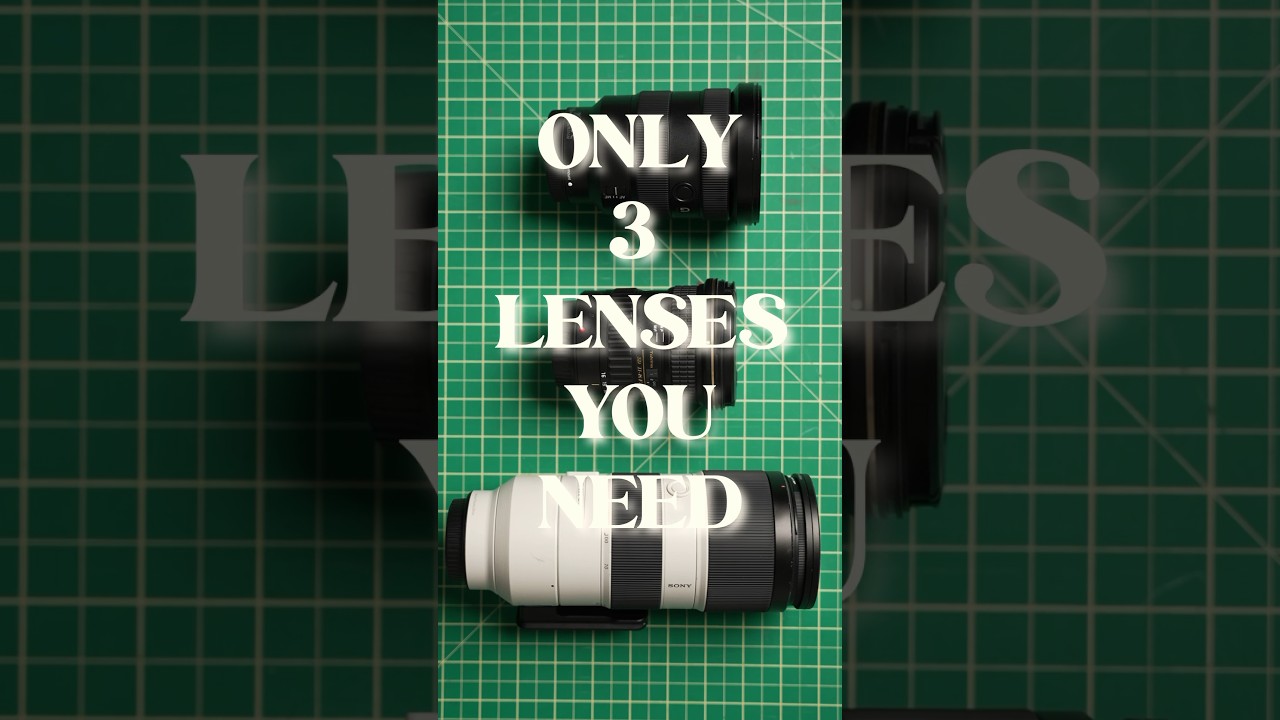
Only 3 Lenses You Need As A Filmmaker, Video By TMS Productions, strips away gear overwhelm so you can concentrate on storytelling and creating stronger images. You’ll get clear guidance and real-world examples that make lens choices simple.
The article outlines the three go-to lenses, when to reach for each, practical framing tips, and budget-friendly alternatives to build a versatile kit. By the end, you’ll know exactly which lenses to prioritize and how to use them to support your vision.
The Essential Three Lenses
Definition of the three-lens concept for filmmakers
You carry less and see more. The three-lens concept asks you to choose three distinct focal types — wide, normal, and telephoto — that together cover most cinematic needs. It’s not a manifesto against gear; it’s a way of setting boundaries so your decisions become intentional rather than accidental. You’ll find clarity in limits: with three lenses, you learn the strengths and compromises of each one and how to tell a story again and again using the same visual tools.
Typical focal lengths that cover the kit (wide, standard, telephoto)
Think in ranges rather than absolutes. For many filmmakers a practical trio might read as roughly 24mm (wide), 35–50mm (standard), and 85–135mm (telephoto) on full-frame. Swap those numbers when you change sensors: multiply by crop factors, but keep the relationship the same — wide to capture space, normal to mimic the eye, tele to compress and isolate. The lens numbers map to feeling: 24mm feels roomy, 50mm intimate, 85mm reserved and selective.
Why three lenses are sufficient for many productions
You don’t need an entire shop to make a film that holds together. With three lenses you cover establishing shots, medium coverage, and intimate close-ups. This trio forces you to design each shot with purpose: you won’t rely on gear to solve problems that should be solved with composition, performance, and movement. For small crews, documentaries, shorts, commercials, and many indie features, three lenses reduce downtime and often yield a more coherent visual language.
Practical prime and zoom examples filmmakers commonly use
People often pair primes for image quality and a single zoom for flexibility. A common practical kit might be a 24mm f/2.8 or f/1.4, a 50mm f/1.8 or f/1.4, and an 85mm f/1.8 or a 70–200mm zoom. If you prefer slightly wider normal coverage, swap the 50mm for a 35mm. If you need reach and convenience, the 24–70 and 70–200 zooms cover wide to mid and mid to long respectively, but you’ll miss some of the optical personality primes give you. Choose what you can carry and what helps you tell the story.
Why Limiting Yourself to Three Lenses Is Powerful
Creative benefits: forcing intentional choices
When you limit your options, you become more deliberate. You’ll notice when a wide shot actually tells something the audience needs to know, or when a telephoto’s compression heightens a character’s loneliness. The constraint sharpens your eye. You start thinking in relationships — subject to background, foreground to midground — instead of in opportunistic switching, and the result is often a stronger, more coherent narrative.
Workflow and speed advantages on set
Fewer lenses mean fewer swaps, fewer trip hazards, and less time fussing with filters and mounts. You move faster. Your assistant moves faster. If you’re a one-person crew you’ll find you can cover more setups in a day because you’re not constantly changing optics. The rhythm of a shoot improves; you’re less likely to lose light waiting to fit a new lens. Speed also keeps performers relaxed — they respond to continuity, not to the churn of gear.
Logistical benefits: weight, transport, and gear management
A smaller kit travels better. Flights, cabs, and stairs are less apocalyptic when your bag is lighter. You’ll be more willing to scout off-beat locations because carrying gear is no longer a commitment device. Less gear also means fewer cases, fewer batteries, and fewer things to misplace. Everything fits in fewer bags and fewer hands.
Budget and maintenance advantages of a smaller kit
You don’t have to buy everything. Three good lenses beat a bag of mediocre ones. Each lens you own will get more use, and that actually reduces long-term maintenance headaches — fewer glass elements to clean, fewer repairs to track. Financially, investing in three reliable optics often yields better image quality than spreading the same budget thinly across many lenses.
This image is property of i.ytimg.com.
Choosing the Wide Lens
Common wide focal lengths and equivalents for different sensors
On full-frame, 16–35mm is classically wide; 24mm is often the sweet spot for a wider but still natural perspective. On APS-C you’re looking at roughly 10–24mm to achieve comparable fields of view; on Micro Four Thirds, about 8–18mm. Remember crop factors: a 24mm on APS-C behaves more like 36mm on full-frame, so choose with sensor size in mind.
Primary uses: establishing shots, interiors, environmental coverage
Your wide lens announces context. It gives the audience spatial information: where people are, how rooms relate to one another, how characters belong to their environment. It’s indispensable for interiors where you can’t step back, and for exteriors where you want to show scale. Use it for establishing shots and for scenes where the relationship between person and space matters.
Distortion and perspective: when it helps and when it hurts
Wide lenses bend truth. They can make a cramped apartment feel claustrophobic or a street feel expansive. That’s often useful. But be careful — faces and edges can stretch at close range, and people’s noses can become personalities. Use distortion stylistically: to emphasize unease or to show oddity. Avoid it when you want naturalistic portraits or accurate proportions.
Recommended aperture choices and sample wide primes/zooms
Choose based on need: f/2.8 or wider if you want shallow depth in close interiors, f/4 can be sufficient if you prefer tack-sharp landscapes. Practical wide options include a 24mm prime for low-light and characterful wide shots, a 16–35mm zoom for flexibility, or a 35mm if you want a slightly less cavernous wide. Pick the aperture that matches your lighting and depth-of-field needs.
Choosing the Standard/Normal Lens
Why the normal lens is the kit’s workhorse
The normal lens approximates human vision and becomes the workhorse because it neither flattens nor dramatically exaggerates. It’s conversational. You’ll use it for medium shots, walking scenes, and most coverage that needs to feel real and intimate without aesthetic interference. It’s where most dialog lives, and where you’ll find a reliable visual baseline.
Typical focal lengths (35mm vs 50mm) and their visual impact
35mm feels slightly wider and more environmental; 50mm reads more intimate and portrait-like. Use 35mm when you want characters in context — hands, bodies, the environment still visible. Use 50mm when you want proximity and privacy. The difference may feel small, but it changes the rhythm of a scene: 35mm invites movement, 50mm invites attention.
Framing and coverage uses: medium shots, walk-and-talks, general scenes
This lens is versatile. You can frame waist-up mediums, over-the-shoulder conversations, and walk-and-talks without drastically altering perspective. It’s forgiving for blocking and actor movement, and it simplifies continuity because you can move the camera a little without changing the emotional read of the shot.
Aperture and depth-of-field considerations for cinematic looks
For cinematic isolation, choose wider apertures like f/1.4–f/2.8 to get pleasing subject separation. But remember focus can be unforgiving; at f/1.4 you’ll need a practiced focus puller or precise manual focus. Stopping down to f/2.8–f/4 gives you more forgiveness and still reads cinematic, especially when paired with framing and lighting that suggest depth.
Choosing the Telephoto or Portrait Lens
Focal length options for tele/portrait use and sensor equivalents
Telephoto choices often cluster around 85mm, 100mm, 135mm on full-frame. On APS-C that becomes roughly 50–90mm equivalents, and on MFT a 45–75mm equivalent. For tight isolation, you might use a 70–200mm zoom, which is a workhorse for reach. Choose focal length based on how much compression and isolation you need and how far you can stand from your subject.
How compression and background separation affect storytelling
Compression brings background elements closer and flattens space; it makes subject and background coexist on a similar plane. That matters narratively: compression can suggest intimacy or constraint, and it can make a subject seem surrounded by something else. Background separation isolates the subject and focuses attention. Both are storytelling tools: use compression to manipulate psychological distance.
Uses: close-ups, interviews, selective focus, action isolation
This lens is your go-to for close-ups and interviews. It isolates faces from clutter and makes small gestures matter. In action, telephoto compresses movement and allows you to pick out a single performer in a crowd. Use it when you want viewers to listen with their eyes and to feel a private observation of the character.
Selecting between a fast prime and a short tele zoom
Primes give you faster apertures and often nicer bokeh. Zooms give reach and flexibility. If you can have only one, choose based on your priorities: if portraits and low-light close-ups are central, a fast 85mm or 100mm prime is invaluable. If you need range and often can’t move, a 70–200mm Zoom is pragmatic. A hybrid approach — fast prime as main, zoom as backup — is a sensible compromise.
Prime Versus Zoom in a Three-Lens Kit
Optical advantages of primes: sharpness and wide apertures
Primes tend to be sharper, have fewer compromises, and allow wider apertures. That means you get cleaner images, better low-light performance, and more consistent character in bokeh and contrast. Optically, primes often have more pleasing micro-contrast and personality, which filmmakers value for their tactile image quality.
When a zoom is preferable for flexibility or reach
Zooms are convenient. On a tight schedule or with limited crew, they let you reframe quickly without a lens change. They’re indispensable when you can’t reposition the camera — for stealthy shoots, moving vehicles, or small spaces. Use them when adaptability matters more than the last stop of optical purity.
Weight, form factor, and on-set efficiency comparisons
Zooms can be heavier, but they reduce packing complexity. Primes spread weight across multiple pieces, but they’re often lighter individually. On set, primes can mean more lens swaps and more time, while a zoom simplifies logistics. Decide whether you prefer fewer pieces to manage or higher image quality and lighter individual items.
Hybrid approaches: using primes for main coverage and a zoom as backup
You don’t have to choose black or white. Many filmmakers shoot with two primes and one zoom — the zoom acts as a safety net for unexpected focal needs. This hybrid approach preserves prime quality for your main shots while keeping a flexible tool handy for run-and-gun situations or unforeseen compositions.
Matching Lenses for Consistency
Color rendering and contrast matching across lenses
Lenses have personalities. Some render warmer, some cooler; some have more contrast out of the box. If you’re using different lenses across a scene, pick glass that plays well together or be prepared to match them in post. Matching color and contrast keeps cuts seamless and prevents the audience from being distracted by a change in tonal character.
Managing edge sharpness, micro-contrast, and resolution differences
Not all lenses resolve the same way. Edge softness and micro-contrast vary, and switching from a high-resolution prime to a softer zoom can create visible discontinuities. Test combinations. Use your most reliable lens for the critical shot, and be mindful of which lens covers midground and background detail.
Lens breathing, focus falloff, and motion continuity
Lens breathing — the slight change in focal length while focusing — affects motion and continuity. Some lenses breathe a lot, which can jolt a pull-focus shot. Focus falloff defines how smoothly out-of-focus areas blur. Keep these characteristics consistent when you plan moving shots, and perform tests to anticipate odd behaviors during a shot.
Practical tests to perform before a shoot to ensure cohesion
Before you shoot, put lenses side by side and record the same scene under the same light. Check color, contrast, bokeh, breathing, and how they react to highlights. Note where each lens needs tweaks in color grading. A short battery of tests saves you messy fixes later and helps you decide which lens to use where.
Sensor Size, Crop Factor, and Focal-Length Equivalents
How full-frame, APS-C, and MFT change your effective focal lengths
Sensor size alters the field of view. A 50mm on full-frame reads differently on APS-C or MFT because of crop factors (about 1.5x for APS-C and 2x for MFT typically). The numbers don’t change, but the effective framing does. So always think in equivalent focal lengths when you move between systems to maintain your visual intent.
Translating prime choices between different camera systems
When you switch systems, translate rather than transplant. If you love a 35mm on full-frame, on APS-C you’ll look for roughly a 24mm to get a similar look, and on MFT a 17–18mm. Keep the psychological roles in mind — wide, normal, tele — and pick focal lengths that preserve those roles on your chosen body.
Recommendations for common mirrorless and DSLR mounts
Most modern mounts have a healthy prime and zoom ecosystem. Prioritize lenses native to your mount to avoid adapters that complicate autofocus and stabilization. If you must adapt, test for electronic compatibility and confirm focus accuracy. Choose mounts and lenses that match your working style: lightweight glass for handheld, robust metal barrels for heavy-duty work.
Why physical lens characteristics still matter beyond the numbers
Focal length and aperture are only part of the story. Build quality, focus throw, bokeh character, flare behavior, and weight all influence how a lens performs in practical filmmaking. You’ll be handling lenses, passing them between operators, and mounting them on gimbals. Choose lenses you enjoy using; the physical feel affects your work as much as the numbers.
Shooting Techniques with a Three-Lens Kit
Planning coverage and lens swaps to maintain pace on set
Plan like you’re cooking for a small dinner party: sequence shots to minimize swaps. Shoot all wide coverage for a scene first, then move to mediums and finally close-ups. That way you change lenses fewer times and keep the actors in rhythm. When possible, block with lens choices in mind so your swaps are intentional and predictable.
Compositional strategies unique to each lens
Think of each lens as a mood. Wide lenses include environment — use leading lines and negative space. Normal lenses center the human, balancing subject and surroundings. Telephoto compresses and isolates — let it reveal subtle expression and texture. Compose with the lens’s temperament in mind, not as a post-hoc fix.
Camera movement, stabilization, and lens choice interactions
Lighter lenses pair better with handheld and gimbal work; heavier telephotos often require stabilization to avoid shake. Movement also changes perceived focal length: push-ins with a wide lens feel different than with a telephoto. Match your stabilization approach to the lens and the emotional tone you want — shaky hand for immediacy, smooth glide for composed distance.
Practical examples: sequence coverage using just three lenses
Imagine a scene: you open wide to show the room and character placement (24mm), move to a 50mm for the conversational medium shots that carry the scene’s beats, and then cut to an 85mm for close-ups that reveal private reactions. You can cover action by alternating these three perspectives and, if necessary, use a zoom for a quick reaction that you didn’t plan. The sequence remains coherent because you repeated the same visual vocabulary.
Conclusion
Summary of why a three-lens kit covers most filmmaking needs
Three lenses give you space, intimacy, and distance. They simplify choices and help you build a consistent visual language without needing a trunk of glass. For most narratives and formats, a wide, a normal, and a telephoto will take you from establishing to emotional close-up with clarity and efficiency.
Final practical recommendations for building your kit today
Start with one reliable lens in each category. If you can, choose at least one fast prime for low light and shallow depth, and a flexible zoom as a safety net. Prioritize lenses that match your camera mount and your shooting style. If budget constrains you, rent a lens you can’t afford to buy and see how it changes your work before committing.
Actionable next steps: tests to run and lenses to try or rent
Run a short test sequence with three candidate lenses: shoot the same scene wide, medium, and tight. Check how they match in color and contrast. Try shooting the scene at your intended apertures and evaluate focus pulls and breathing. Rent the single lens you’re unsure about for a real shoot day to see how it behaves under pressure.
Encouragement to prioritize storytelling over gear accumulation
You’ll always want more glass. That’s fine. But the story is always the point. The “Only 3 Lenses You Need As A Filmmaker” idea — which you might have seen in the Video By TMS Productions — isn’t a limitation so much as an invitation. Use fewer tools to sharpen your choices. Let the work demand the gear, not the other way around. In the end, the audience cares about the story, and you care about truth. Keep those priorities and your kit will serve you rather than define you.